
The Status of Montana Women: Advancing Policy for Economic Equity
Progress and Possibility: Building a Better Future for Montana Women
Montana is a state that was and continues to be built by women. Women power the economy, serve as the cornerstone of our families, and advance policies that move us all forward.
The report you’re about to read highlights the hard-earned progress Montana women have made, detailing the tangible improvements from passing policies like expanded Medicaid and establishing the constitutional right to access an abortion and reproductive health care.
It also takes a candid look at the barriers women face as they shape our state’s future, showing with pointed data that though we’ve made real progress, the work isn’t done.
With support from the Women’s Foundation of Montana, the Montana Budget & Policy Center has again documented the state’s persistent wage and wealth gaps and the undervaluing of caregiving work predominantly performed by women. It also shows how women of color and 2SLGBTQIA+ (Two-Spirit, Lesbian, Gay, Bisexual, Transgender, Queer or Questioning, Intersex, Asexual) women face compounding hurdles.
The report illustrates how even past advancements like expanding Medicaid can be curtailed, such as through recent efforts to redetermine eligibility for those who were covered, resulting in more women going without health insurance.
It offers a roadmap, though, for what to do next: from supporting policies that expand access to child care, which increase the ability for women to participate in the workforce; to increasing grants for economic development in Indian Country; and more investment in shelter services for survivors of domestic violence.
This report would not be possible without the Montana Budget & Policy Center, whose work brings clarity to complex challenges and turns data into a resource for informed action.
Now, the responsibility belongs to all of us. The findings in this report are not just information; they offer a blueprint for going forward. We all play a role in shaping a Montana where women can thrive. By supporting policies that invest in women, we build a better future for us all.


Women in Montana have a long history of economic contributions and success. Women are the backbone of Montana’s economy, playing a critical role in essential industries like caretaking, nursing, and education that have ripple effects for the workforce as a whole. Women are business owners, helping to keep our local economies running. In addition to contributing to our economy and communities, women push for advancements in legal protections and rights that help the next generation start off with a more fair playing field. However, due to systemic barriers rooted in outdate gender norms, women are still underpaid relative to men, are more likely to work in industries where their expertise is undervalued, and face disproportionate threats to their personal safety and wellness. For Montana women with intersecting marginalized identities, including women of color and LGBTQ+ women, these barriers are often compounded by additional layers of exclusion. Tracking and evaluating the economic status of women in Montana is important to help target policies that work to improve equity. This report highlights historical successes in improving economic outcomes for Montana women and identifies solutions to help close the gaps.
How did we get here?
Montana has a history rich in strong, influential women. Over the last couple of centuries, Montana has made steady improvements in laws protecting women and establishing fair labor standards. While these changes are not perfect and women face many barriers even today, Montana women have created lasting change over more than the past hundred years, here are just a few examples of that forward momentum.

1913: More than two-thirds of both houses of the legislature pass a constitutional amendment to establish laws allowing women to vote in general elections.[1] Montana voters approved the amendment that November. This allows women to vote if they are citizens, over the age of 21, not a felon, and have resided in Montana one year before the election is held. However, the United States government did not recognize Native Americans as citizens until 1924, and thus, Indigenous women were blocked from voting. The passage of the amendment was the result of a multifaceted organizing campaign involving hundreds of women across the state.[2]
1919: The Montana Legislature passes a law making it illegal to pay women less than men for the same work.
1939: Women become eligible for service on a jury.
1971: The Montana Legislature passes legislation ensuring an individual’s right to be free from discrimination based on race, creed, color, sex, or national origin in the workplace and in public.
1972: The Montana Constitutional Convention includes Section 4, Individual Dignity: “The dignity of the human being is inviolable. No person shall be denied the equal protection of the laws. Neither the state nor any person, firm, corporation, or institution shall discriminate against any person in the exercise of his civil or political rights on account of race, color, sex, culture, social origin or condition, or political or religious ideas.”
1975: The Montana Legislature improves many laws with more inclusive language to disallow discrimination against women, including employment protections for women who are pregnant. Thus, an employer can no longer end a women’s employment because of her pregnancy or otherwise deny her benefits or grant her a leave of absence.
1979: The Legislature appropriates $375,000 to provide expanded day care for families that make less than 75 percent of the state’s median income.
1985: The Legislature passes the domestic abuse act which defines domestic abuse as a crime and provides requirements for how police officers and judges respond to domestic abuse cases.[3]
2017: The Legislature establishes strangulation as a felony and changes how sexual abuse statutes define consent.[4] Previously, prosecutors had a difficult time convicting offenders who had strangled a partner in domestic abuse cases, as they had to prove substantial risk of death or serious bodily injury, and strangulation injuries are often internal. The changes to consent moved toward a focus on what the perpetrator did, rather than having to prove a victim resisted.[5]
2023: The Legislature appropriates $7 million a year to increase the Best Beginnings Scholarship eligibility that helps families with low incomes afford child care.[6]
Economic Opportunity
Despite possessing higher educational achievements than men, women face economic and social barriers that result in lower incomes and lower labor market participation. Wages in Montana are lower than the national average, and this holds true for Montana women. Like the nation, women in Montana see a significant wage gap by sex, even after accounting for differences in occupation, full-time status, educational levels, and experience. While women’s labor force participation is strong, Montana women still find themselves trailing behind men in workforce participation. This is partly due to the significant responsibilities they carry in caregiving roles and the societal expectations placed on them as parents.
Income and Wealth
Women in Montana earn 71 cents for every dollar men earn, similar to the national average.[7] This is due in part to historical and present practices and policies that keep women and other marginalized groups, including but not limited to people of color, LGBTQ+, and people living with disabilities, from earning equivalent incomes to white men. This discrepancy in pay between men and women is known as the gender pay gap. The gender pay gap has persisted, narrowing slightly, over the past 20 years.[8]

While there are differences between the average female worker and the average male worker, like types of occupations, levels of experience, and educational differences, much of the gender pay gap cannot be explained by any measurable differences and can be assumed to be implicit bias or discrimination.[9] Among the explainable differences, women are more likely to work in nurturing or caregiving, and historically undervalued and lower-paying occupations like social work, education, and nursing. Even within the same occupations, women earn less on average than men.[10] There is also a significant wage gap at every level of education.[11]
Child care workers in Montana, who are predominately women, are one example of an underappreciated and underpaid occupation. While child care makes up a big expense for families, child care workers make low wages despite the essential nature of this work. The reality of today’s child care profession has been shaped by decades of policies and public perception that devalued the role of caring for young children. For example; the Fair Labor Standards Act of 1938, a law that protects workers against certain unfair pay practices, excluded domestic, agricultural, and service occupations.[12] This exclusion reflects a policy choice that failed to recognize the value of caregiving labor, building on a longer history in which enslaved Black women were forced to provide unpaid domestic and caregiving work, and Indigenous women were displaced and often pushed into low-paid service roles through colonial policies. These systems disproportionately shaped the experiences of Black, Indigenous, and women of color, whose labor has long sustained families and communities without fair recognition or compensation. Over time, additional policies reinforced this pattern, setting a precedent for undervaluing caregiving as skilled and essential work. That legacy continues today in an underpaid and undervalued child care workforce.

The pay gap is even worse for Black, Indigenous, and women of color.[13] Women have lower incomes than men on average, and Black, Indigenous, and people of color have lower incomes than white people on average.[14] For Black women, their earnings represent just 58 percent of the earnings of white men.
Wealth and income are related but different concepts. Income is money one receives regularly, like wages, for day-to-day expenses like housing, food, utilities, clothing, and school supplies. Wealth is the accumulation of savings; like money in the bank, stock investments, or property someone owns. It can be used in times of financial crisis and invested to improve future financial stability through things like purchasing a home or investing in higher education. Wealth is often passed from generation to generation, so policies that have kept some groups from accumulating wealth, like federal redlining policies that blocked Black households and other communities of color from accessing home mortgages and owning homes for decades, have long-standing implications on wealth for future generations of families of color.[15]

Like individuals of color, women are also subject to a wealth gap, called the gender wealth gap. Historically and presently, women have been systematically disadvantaged in terms of wealth compared to men, largely because of practices like employment bias and limited opportunities to access credit. While much is known about the gender pay gap, the gender wealth gap is much less researched.[16] Estimates vary, with some suggesting that female-headed households in the United States hold 71 cents of wealth for every dollar held by male headed households, similar to the wage gap, controlling for several factors. However, due to a lack of available data, many assumptions were needed to come to these estimates, and wealth gaps rise as a whole when taking race into consideration.[17] These differences are rooted in a history of unequal access to resources and financial systems. While data constraints require assumptions, racial disparities are even more severe: Black women, shaped by systemic exclusion from wealth-building, hold only about 6 cents for every dollar held by white men.[18]
Cash support policies that reach families with the lowest incomes, like the federal child tax credit expansion in 2021, help to improve gender and racial income disparities by offering support to female-headed households and households of color. The 2021 expansion lifted 1.5 million women out of poverty nationwide, and helped many Montana families.[19] In tax year 2021, 114,700 Montana families received the child tax credit, which dropped in half to 47,670 in 2022 after the expansion expired.[20]
Labor Force Participation
Challenges in accessing affordable child care has resulted in lower workforce participation among women. In Montana, women’s labor force participation rate is 76 percent, compared to 83 percent for men.[21] More than 68,000 children younger than six live in Montana, and 67 percent of these children have all parents in the workforce.[22], [23] In 2024, approximately 63,000 parents, or 11 percent of all Montanans working or actively looking for work, were unable to fully engage in the workforce due to family responsibilities and a lack of child care.[24] Access to quality, affordable child care is essential for parents to participate in the workforce consistently.
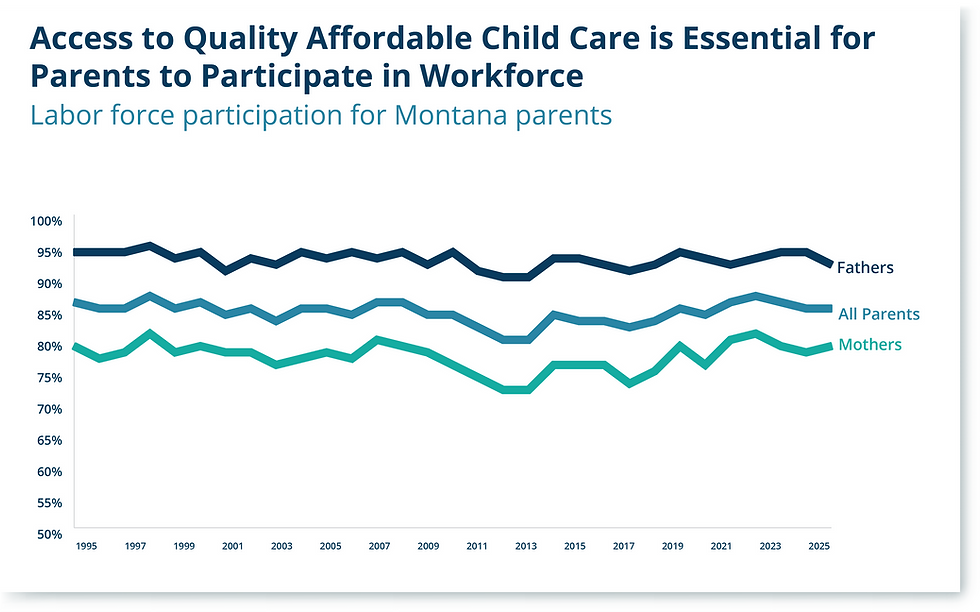
Parents who are primary caregivers face significant barriers in their ability to get ahead financially. The “motherhood penalty” or a decrease in wages after women have children, holds strong for all women, including higher-earning women and female breadwinners.[25] After having children, women experience a permanent setback in their likelihood of working and a temporary drop in earnings.[26] Public policies can help to reduce this wage effect. In countries with public policies that support families like high-quality public child care and paid parental leaves, mothers are usually more competitive in the workforce.[27]
Women’s workforce participation has increased over time in the United States and Montana. In the early 20th century, most women did not work outside the home, with only 20 percent of women gainfully employed.[28] Black women were roughly twice as likely as white women to work outside the home, driven in part by higher participation among married women and shaped by a history of unequal economic opportunity. Today in Montana, women and people of color experience barriers to working full-time, including societal expectations on caregiving responsibilties and a lack of job opportunites in rural communities. Women of color and white women have lower labor force participation than their male peers, and both Indigenous men and Indigenous women experience disproportionately low labor force participation.[29]
Business Ownership
Across the state, nearly 40 percent of businesses are women-owned or co-owned by men and women, including in sectors critical to our state’s economy such as education.[30] However, women in Montana still own businesses at a much lower rate than men, and this disparity is even more pronounced for people of color. While 6.4 percent of the Montana population is Indigenous, people of color as a whole only own 5 percent of businesses.[31]

The lack of access to capital for small businesses is a major barrier affecting lower business ownership rates for women and people of color-owned businesses.[32] In a 2022-2023 survey of lenders, investors, state and federal agencies, and foundations that fund Montana small businesses, only 36 percent of loans or investments were made to women while 64 percent were made to men. Nearly three-quarters (74 percent) of the loans or investments were made to white business owners. These facts illustrate the need for more support for women and people of color-owned businesses.
Health and Well-Being
Reproductive Rights
Empowering women with access to health care options and choices when it comes to family planning can bolster their other goals like wages, education, and health. Women’s lifelong economic outcomes are linked to the age at which they first have children. Access to sexual education, contraception, and abortion grants women the autonomy to delay the unexpected start of parenthood, resulting in a significant increase in women’s earnings and education, labor force participation, and occupational prestige.[33] Access to abortion not only improves the financial health of women, it also improves mental and physical health.[34] Fortunately, Montana’s Constitution protects the right to abortion.[35] The 2024 Montana electorate passed CI-128 which protected the right to make and carry out decisions about one’s own pregnancy.
Health Care
Montana women age 19-64 have health care coverage at a similar rate as the national average.[36] Health insurance is important to economic well-being, by safeguarding individuals’ health, ability to work, and care for their families.

Montana passed Medicaid expansion in 2015, providing lifesaving and affordable medical care to tens of thousands of Montanans.[37],[38] Medicaid provides health insurance for adults up to 138 percent of the federal poverty level ($37,702 for a family of three in 2026).[39] Medicaid expansion has increased health care coverage for women in Montana. Following Medicaid expansion, health insurance coverage for women in Montana increased while the percentage of uninsured women age 19-64 dropped from 14.9 percent in 2015 to 9.9 percent in 2016.[40] However, recent efforts by the state to redetermine eligibility have resulted in a loss of health care coverage and an uptick in the share of women who are uninsured.
Women tend to have better access to health insurance than men, partly because a greater number of women qualify for Medicaid, as their incomes are typically lower on average.[41] Medicaid expansion has also resulted in a higher likelihood of health care coverage among transgender people.[42] Thus, Medicaid and Medicaid expansion help ease some of the burden of the gender pay gap.
Medicaid is a significant payer of family planning services. In Montana in 2023, over 40 percent of all births were financed by Medicaid.[43] Medicaid expansion has increased prenatal and postpartum coverage, prior to and during pregnancy. Expansion is associated with increased use of contraception, prenatal care, HIV testing and access to care, as well as improvements on maternal mortality and morbidity.[44]
Expansion increases access to health care, but there is room for improvement. While Montana extended postpartum coverage to one-year for those on pregnancy Medicaid, the income cut-off for pregnancy Medicaid (162 percent of the federal poverty level, or roughly $24,397 for an individual) is one of the ten lowest states in the nation.[45] Additionally, half of Montana counties are classified as “maternity care deserts,” in other words, areas that have little to no health providers to provide materinity care services. For American Indians living in areas with less access to maternity care and other social services, over 45 percent receive inadequate prenatal care.[46]

While Medicaid has expanded health care access, many women still face discrimination when seeking health care. Women, especially low-income women and women of color, are more likely to report facing discrimination from health care providers than men.[47]
Indigenous women in Montana face additional challenges navigating the health care system with a persistently underfunded Indian Health Service (IHS). Current funding for IHS covers only 60 percent of the health care needs of eligible American Indians.[48] Compared to other government-funded health programs, IHS spends far less per recipient.[49] In Montana, the average cost per enrollee on Medicaid expansion was around $6,012 in 2023.[50] The amount spent per person through IHS in FY 2023 was $4,078.[51]
Missing and Murdered Indigenous People
Missing and Murdered Indigenous People (MMIP) refers to the epidemic of violence against American Indians. Factors such as intimate partner violence, human trafficking, lower wages, and housing insecurity increase the risk of women experiencing violence.[52] For Indigenous women and Two-Spirit people, these risks are compounded by both historical government policies, such as forced removal, land seizures, and violence, as well as more recent factors such as the man camps of the Bakken Oil Fields.[53]
Indigenous Montanans disproportionately account for missing person cases in Montana, making up 26 percent of cases despite representing only 6.4 percent of the population.[54],[26] Women are at particular risk, with 84 percent of American Indian women reporting violence at some point in their life, and 56 reporting sexual violence.[55] The Legislature passed two bills to address the MMIP crisis in 2025, including a bill creating a state special revenue account for the MMIP task force, and a bill renaming the “Missing and Murdered Indigenous Persons Advisory Council” and extending the council’s ability to support cases of homicide with the addition of a homicide investigator.[56]
Safety
Domestic violence is abusive behavior as part of a systematic patttern of power and control perpetrated by one intimate partner against another.[57] With one in three women and one in four men having experienced some type of physical violence by an intimate partner, women are disproportionately victims of domestic violence. Since 2000, approximately 286 Montanans have died in family violence homicides.[58] These fatalities represent a small piece of a societal problem of domestic and sexual violence. Abusers’ access to firearms increases the risk of women dying as a result of physical violence from their intimate partner at least five-fold.[52]
Montana’s passage of the domestic abuse act in 1985 and legislation in 2017 establishing strangulation as a felony and redefining consent made great strides in ensuring domestic abusers are held accountable for their actions.[59], [60]
Political Participation
Women in Montana vote at a similar rate as men.[61] Shaped in part by this nation’s history of voter suppression laws targeting people of color and barriers to voting access faced by Indigenous Montanans, white Montanans are more likely to vote than Montanans of color. [62],[63] All Montanans should have equal access to the voting booth, a right that Montanans fight for every day, continuing Montanans’ historical battles to access democracy. Women are under-represented in the Montana Legislature, peaking at 34 percent of the members in 2025.[64] This trend holds true at the national level as well.[65] While Montana elected the first Congresswomen, Jeannette Rankin, in 1916, she remains the only woman member of Congress from Montana to date.[66]
Female lawmakers are more likely to push for policies that support women and families, like education, health, and income support for families with low incomes.[67] Thus, the underrepresentation of women in the elected bodies results in fewer laws that help to improve economic, health, and other outcomes for women and families.
Improving Lives for Families in Montana
Improving gender equality in Montana is possible. Public policies that help improve workforce outcomes for women and families can help increase women’s earnings and lower the gender pay gap. Policies that help reduce gender inequality also help all Montanans thrive. For example, a state or federal paid family medical leave policy would support both men and women with caregiving responsibilities and allow them to take care of themselves and their family members when they become ill or need assistance. Policies that help women to more fully participate in the workforce, like a state investment in child care, strengthen our workforce, increasing the number of available qualified applicants for current employers. As women are more educated than men on average, policies that help women to participate in the workforce can play a critical role in easing workforce shortages.

Paid Family Medical Leave
A state paid family medical leave policy would pool small contributions from employers and employees to create a funding stream for workers when they need to take time off to care for themselves or a loved one.[68] Several states have state family medical leave policies, helping stabilize and improve the workforce, attract workers and families, and improve families’ well-being, public health, and the overall economy.
Child Care
High-quality and reliable child care is a critical component of a modern and thriving economy. In 2023, Montana invested state dollars to expand the Best Beginnings child care scholarship program to more families.[6]

Montana should continue the success of 2023 by expanding the Best Beginnings child care subsidy program to the federal maximum level to support more working parents with affordable child care. To support the critical child care industry and help retain workers, Montana should look to other states like North Dakota, Utah, Iowa, and Kentucky, that have extended eligibility for child care scholarships to cover all child care workers who are also parents.
Missing and Murdered Indigenous People
During the past two legislative sessions, representatives across Indian Country have listened to their communities’ concerns and successfully enacted legislation in an effort to halt the MMIP epidemic. The 2025 Legislature created a state special revenue account for the MMIP task force and and extended the council’s ability to support cases of homicide with the addition of a homicide investigator. Lawmakers must continue to invest in finding solutions to the MMIP epidemic, including continued funding for community response efforts and implementing the MMIP task force solutions.
Investment in Tribal Colleges
Tribal colleges play a vital role in offering many Montanans, both Indigenous and non-Indigenous, with a pathway to higher education and the ability to prepare for the workforce. Montana is home to seven of the 37 Tribal colleges and universities in the nation; more than any other state.[69]
In 1995, Montana began appropriating state dollars toward reimbursing Tribal colleges for the education of resident full-time nonbeneficiary students, now called the Tribal College Assistance Program (TCAP). However, state funding for nonbeneficiary students at tribal college remains well below state funding for students at community colleges across the state.
Increasing state funding for nonbeneficiary students at Tribal colleges to align with community college funding would increase educational opportunities for many Montana students, many of whom who are parents, come from households with low incomes, and are women.
Tax Credits for Families
One of the best ways to reduce the gender wage and wealth gaps is through tax credits for families with lower incomes, like the earned income tax credit and child tax credit. The 2021 federal child tax credit expansion lifted 1.5 million women out of poverty. Seeing the benefits of the temporary federal expansion, many states have passed state child tax credits.[70] Over 40 percent of households with children receiving federal cash support programs, including food assistance and social security income, are single female-headed households.[71] Montana lawmakers have a chance to make a real difference by enhancing cash support for families facing financial challenges. Potential policies include targeted state tax credits like a state child tax credit or an increase to the earned income tax credit.
Investment in Indian Country Economic Development Grants
The Indian Country Economic Development (ICED) program makes a significant contribution toward improving the economic conditions on reservations in Montana.[72] These investments create and grow tribally-owned enerprises, as well as the private business sector on reservations.
The Legislature should increase funding for ICED to provide support needed to conduct sustainable economic development in Indian Country.
Maternal Health Care
Medicaid has helped Montana women access affordable health care, resulting in better financial stability and better health for recipients. Montana can further improve health care access by raising the eligibility of Medicaid for pregnant and postpartum women from 162 percent of the federal poverty level to 185 percent, further ensuring stability during a critical time for health care.
Montana also must ensure that Montana women can count on having safe maternal health. Montana should look to Tribal stakeholders and invest in community-driven solutions to improve maternal health outcomes. Solutions must recognize the intersectionality of maternal health policy accounts for the compounding effects of racism, poverty, geographic isolation, and underfunded federal trust responsibilities.
Safety
Improvements in women’s safety helps build up Montana communities for future generations. Children living in stable homes are more likely to succeed in school, setting them up for success in adulthood.[73]
Survivors of crime deserve safety, support and comprehensive services to recover from the crimes committed against them. Until recently, the vast majority of funding for Montana services was from the federal government, which has been decreasing for more than a decade. In 2023, Montana started to supplement this funding. However, the many years of funding decreases have prevented Montana's critical victim services programs from keeping up with the substantial need. Montana must increase its investments in this system to ensure that survivors in every part of the state have the tools they need to recover, thrive, and participate in the criminal justice system to ensure that offenders are brought to justice.
Political Participation
All Montanans should have equitable access to participate fully in our democracy. To ensure every citizen has an equal opportunity to take part in all elections and uphold the voting rights of American Indians, lawmakers should must invest state funds to create more equitable and accessible voting locations and services on reservations. With the consent of Tribal Nations, satellite election offices on Tribal reservations would cut the distance, cost, and time by providing the same services for voters living on reservations as county election offices. Funding could also provide funds to the Secretary of State for a tribal voting rights coordinator.
Montana has a multitude of opportunity for investments to improve economic outcomes for women. By investing in policies that support women’s full economic participation, Montana can grow its workforce, improve family financial security, and ensure that the next generation is able to contribute to their full ability.
[1] Gibson, R., et al., Montana Women’s History, Montana Historical Society, accessed Feb. 2026. Please see this timeline for a more comprehensive Montana Women’s History than is provided in this report.
[2] Montana Historical Society, Montana Women’s History: Suffrage, accessed Feb. 2026.
[3] Women’s Law Caucus, “Montana’s New Domestic Abuse Statutes: A New Response to an Old Problem,” Vol. 47, Issue 2, July 1986.
[4] Office of Consumer Protection and Victim Services, “Report to the Legislature: Montana Domestic Violence Fatality Review Commissions,” Department of Justice, Aug. 2019.
[5] Young, K., personal communication, Montana Coalition Against Domestic and Sexual Violence, Mar. 2026.
[6] Montana 68th Legislature, “An Act Providing for the Best Beginnings Child Care Scholarship Program,” HB 648, enacted on Apr. 28, 2023.
[7] U.S. Census Bureau, “Median Earnings in the Past 12 Months, 2024 American Community Survey 5-Year Estimates, Table B20017,” accessed Jan. 13, 2026.
[8] Fry, R. and Aragao, C., “Gender Pay Gap in U.S. has Narrowed Slightly over 2 Decades,” Pew Research Center, Mar. 4, 2025.
[9] Kochhar, R., “The Enduring Grip of the Gender Pay Gap, Pew Research Center,” Mar. 1, 2023.
[10] U.S. Department of Labor, “Employment and Earnings by Occupation,” accessed Jan. 13, 2026.
[11] Houghton, K., et al., “Gender Pay Gap Similar Among Certificate Degree Graduates and Those from Highly Selective Bachelors Degree Programs But Reasons Why Differ,” U.S. Census Bureau, Feb. 22, 2024.
[12] Lloyd, C., Carlson, J., Barnett, H., Shaw, S., Logan, D., “Mary Pauper: A Historical Exploration of Early Care and Education Compensation, Policy, and Solutions,” Child Trends, Sep. 2021.
[13] Kang, M., et al., “Introduction to Women, Gender, Sexuality Studies,” University of Massachusetts Amherst Libraries, 2017.
[14] U.S. Census Bureau, “Median Earnings in the Past 12 Months, 2024 American Community Survey 5-Year Estimates, Table B20017,” accessed Mar. 2, 2026.
[15] Gerkin, M. et al, “Assessing the Legacies of Historical Redlining,” Urban Institite, Jan. 2023.
[16] Kent, A. and Ricketts, L., “Gender Wealth Gap: Families Headed by Women Have Lower Wealth,” Federal Reserve Bank of St. Louis, Jan. 2021.
[17] Kent., A., “The State of U.S. Household Wealth,” Federal Reserve Bank of St. Louis, June 23, 2025.
[18] Holder, M., “How Do Wage Gaps Affect Black Women’s Wealth Attainment, and Where Do Expenditures Fit In?,” Urban Institute, Dec. 2023.
[19] Menefee, K., et al., “Restoring the Child Tax Credit Expansion Will Help Women and Children,” National Women’s Law Center, Sep. 25, 2023.
[20] Internal Revenue Service, “SOI Tax Stats – Historic Table 2, Montana, 2021 and 2022” accessed Mar. 4, 2026.
[21] U.S. Census Bureau, “Employment Status, 2024: ACS 5-Year Estimates Subject Tables, Table S2301,” accessed Mar. 4, 2026.
[22] Montana KIDS COUNT Data Center, “Child Population by Single Year of Age in Montana,” accessed Mar. 19, 2026.
[23] U.S. Census Bureau, “Age of Own Children Under 18 Years in Families and Subfamilies by Living Arrangements by Employment Status of Parents, American Communty Survey 5-Year Estimates, Table B23008, 2024,” accessed Mar. 19, 2026.
[24] Watson, A., et al., “Labor Day Report,” Department of Labor and Industry, 2025.
[25] Almond, D., et al., “Large Motherhood Penalties in US Administrative Microdata,” National Academy of Sciences, July 18, 2023.
[26] Sandler, D and Szembrot, N., “New Mothers Experience Temporary Drop in Earnings,” U.S. Census Bureau, Jun. 16, 2020.
[27] Cukrowska-Torzewska, E. and Matysiak, A., “The Motherhood Wage Penalty: A Meta-Analysis,” Social Science Research, May-Jun. 2020.
[28] Yellen, J., “The History of Women’s Work and Wages and How It Has Created Success for Us All,” The Brookings Institution, May 2000.
[29] Center on Budget Policies and Priorities analysis of U.S. Census Bureau’s 2024 5-year American Community Survey public use file, received Mar. 19, 2026, on file with author.
[30] U.S. Census Bureau, “Annual Business Survey, Table AB2300CSA01,” 2023. Due to small sample sizes, “minority” as a whole was used.
[31] U.S. Census Bureau, “QuickFacts Montana,” accessed Mar. 9, 2026.
[32] Isern, J., Baldridge, J., and Unterschuetz, K., “Access to Finance in Montana: A Survey of the Funding Landscape for Entrepreneurs and Small Businesses, Part 1,” Accelerate Montana and Catalyze Global Impact LLC, 2023.
[33] Abboud, A., “The Impact of Early Fertility Shocks on Women’s Fertility and Labor Market Outcomes,” American University of Beirut Department of Economics, Jul. 26, 2023.
[34] Foster, D., “The Turnaway Study,” Scribner, 2020.
[35] Mont. Const., Article II, Section 36.
[36] KFF, “Health Insurance Coverage of Women 19-64,” 2024. KFF, “Women’s Health Insurance Coverage,” Dec. 12, 2024.
[37] Mont. Code Ann., Title 53, Chapter 6.
[38] Department of Public Health and Human Services, “Montana Medicaid Enrollment Dashboard,” accessed Mar. 9, 2026.
[39] U.S. Department of Health and Human Services, “HHS Poverty Guidelines for 2026,” accessed Mar. 9, 2026.
[40] KFF, “Health Insurance Coverage of Women 19-64,” accessed Mar. 9, 2026.
[41] KFF, “Women’s Health Insurance Coverage,” Dec. 12, 2024.
[42] Guth, M., and Diep, K.,, “What Does the Recent Literature Say About Medicaid Expansion?: Impacts on Sexual and Reproductive Health,” KFF, Jun. 29, 2023.
[43] Department of Public Health and Human Services, “Montana Medicaid Births Dashboard,” accessed Mar. 9, 2026.
[44] Guth, M., and Ammula, M., “Building on the Evidence Base: Studies on the Effects of Medicaid Expansion, February 2020 to March 2021,” KFF, May 6, 2021.
[45] KFF, “Medicaid Postpartum Coverage Extension Tracker,” Feb. 24, 2026.
[46] March of Dimes, “Where You Live Matters: Maternity Care in Montana,” accessed Mar 10, 2026.
[47] Long, M., et al, “Women’s Experiences with Provider Communication and Interactions in Health Care Settings: Findings from the 2022 KFF Women’s Health Survey,” Feb. 22, 2023.
[48] Indian Health Service, “Frequently Asked Questions,” accessed Mar. 2026.
[49] Bahr, J., “Medicaid Expansion in Indian Country: Improving the Health of Individuals and Communities,” Montana Budget & Policy Center, Mar. 2024.
[50] KFF, “Medicaid Spending Per Full-Benefit Enrollee,” 2023.
[51] Indian Health Service, “IHS Profile,” Oct. 2024.
[52] Brooklyn Public Library, “Missing and Murdered Indigenous Persons (MMIP),” accessed Mar. 9, 2026.
[53] Congressional Research Service, “Missing and Murdered Indigenous People (MMIP): Overview of Recent Research, Legislation, and Selected Issues for Congress,” Jan. 10, 2022.
[54] Department of Justice, “Looping in Native Communities: A Report to the State-Tribal Relations Interim Committee,” Sept. 1, 2020.
[55] U.S. Department of the Interior Bureau of Indian Affairs, “Missing and Murdered Indigenous People Crisis
Violence Against Native Americans and Alaska Natives far exceed national averages,” accessed Mar. 11, 2026.
[56] Montana Budget & Policy Center, “2025 Tribal-State Legislative Impacts,” July 15, 2025.
[57] National Coalition Against Domestic Violence, “Domestic Violence in Montana,” 2020.
[58] Division of Criminal Investigation, “Montana Domestic Violence Fatality Review Commission Report for 2025,” Department of Justice, Jan. 2025.
[59] Women’s Law Caucus, “Montana’s New Domestic Abuse Statutes: A New Response to an Old Problem,” Vol. 47, Issue 2, July 1986.
[60] Young, K., personal communication, Montana Coalition Against Domestic and Sexual Violence, Mar. 2026.
[61] U.S. Census Bureau, “Reported Voting and Registration of Total Voting-Age Population, by Sex, Race and Hispanic Origin, for States, Table 4b” Nov. 2024.
[62] Anderson, C., “One Person, No Vote: How Voter Suppression is Destroying our Democracy,” Bloomsbury Publishing, 2018.
[63] Bahr, J., “Access to the Ballot: Uphold Democracy by Strengthening the Indigenous Vote,” Montana Budget & Policy Center, June 2022.
[64] Legislative Services, “Women in the Montana Legislature, 1971-Present,” accessed Mar. 12, 2026.
[65] Schaeffer, K., “The Data on Women Leaders,” Pew Research Center, Sep. 27, 2023.
[66] United States House of Representatives, “Jeannette Rankin,” accessed Mar. 12, 2026.
[67] Miller, C., “Women Actually Do Govern Differently,” New York Times, Nov. 10, 2016.
[68] O’Loughlin, H., “HB 651 – Montana FAMLI Act: A Policy Design Supporting Families and Businesses,” Montana Budget & Policy Center, Feb. 2023.
[69] Kindness-Coleman, I., “An Outstanding Return on Investment: Tribal Colleges and Their Contributions to Montana,” Jan. 2025.
[70] Davis, A. and Butkus, N., “States are Boosting Economic Security with Child Tax Credits in 2023,” Institute on Taxation and Economic Policy, Sep. 12, 2023.
[71] U.S. Census Bureau, “Receipt of Supplemental Security Income (SSI), Cash Public Assistance Income, or Food Stamps/SNAP in the Past 12 Months by Household Type for Children Under 18 Years in Household, 2024 American Community Survey 5-Year Estimates, Table B09010,” accessed on Mar. 12, 2026.
[72] Parish, P., “Economic Development in Indian Country: A State Investment with Continued Returns,” Jan. 2021, Montana Budget & Policy Center.
[73] Bhuller, et. al., “Domestic Violence Reports and the Mental Health and Well-Being of Victims and Their Children,” The Journal of Human Resources, 2023.


The 2026 report on the status of slope run women in Montana shows progress driven by policies such as Medicaid expansion and guaranteed access to reproductive healthcare, yet significant gaps in income, capital, and economic opportunities persist.
What a genuinely interesting article, answering a question that had been on my mind for quite some time. The author's explanation was thorough enough that I didn't need to look anywhere else afterward. That thoroughness made this feel like exactly the resource I'd been hoping to come across. To find out more, the piece links to some worthwhile related reading. Thanks for such a complete and satisfying piece.
Readers who explore our content can find many useful ideas presented in an approachable style. This article is a good example of clear and thoughtful writing. The author explains the subject without introducing unnecessary complexity. I especially appreciated the practical examples. The conclusion highlights the most important points effectively. Thank you for sharing this informative post.
Readers can discover useful information throughout this clear and well-organized article. The author explains the topic in a way that feels natural and approachable. I especially appreciated the practical examples. They made the main points easier to understand. The conclusion provided a helpful overview. Thank you for sharing this valuable post.
Consultar la loteria nacional resulta mucho más cómodo gracias a una plataforma que reúne resultados recientes, sorteos organizados y actualizaciones continuas. Todo está diseñado para brindar una experiencia clara, práctica y fácil de utilizar.