
Montana’s Administration of Medicaid and Poor Customer Service Costs People and the State
Updated: May 15
In 2015, Montana expanded Medicaid to cover more people with low and moderate incomes. Over the past ten years, it has reduced the number of uninsured residents.1 Medicaid also eased the burden of uncompensated care on hospitals and supported jobs through increased federal investment. Medicaid expansion is not just a health policy; it is a lifeline for working families and a cornerstone of Montana’s economic stability.2
However, for Montanans applying for Medicaid there are barriers and challenges, such as slow application processing and long wait times on the helpline. These obstacles are created by the state and its program administration.3 While federal regulations dictate much of how Medicaid operates, the program is state-administered, meaning it handles claims, enrollment, applications, and other aspects of customer service and access. Administering the program can be complicated, but there are concrete ways the state can improve its systems to ensure eligible Montanans can access coverage.[3]

Montana Performs Deficiently in Medicaid Administration Compared to Other States
The Centers for Medicare & Medicaid Services (CMS) oversees Medicaid programs at the federal level. States are required to report to CMS on its application processes and operations. Montana has consistently ranked low on these metrics, including significant delays in application processing, long wait times on the state’s help line, and procedural denials of applications. As of November 2025, Montana ranked in the bottom 25 percent in five of eight administrative performance categories reported to CMS.4
Montana’s procedural disenrollment rates varied significantly over the last two years.5 In November 2025, the procedural disenrollment rate increased to 81 percent, higher than the national average, signaling serious breakdowns in the renewal process rather than changes in eligibility. Procedural disenrollment typically occurs when paperwork is not completed on time or processing issues prevent eligible individuals from maintaining coverage. When eligible people lose coverage due to administrative hurdles, they reapply, creating a cycle known as “churn.”19 This cycle increases the workload for the state and interrupts care for patients who rely on consistent coverage. Meanwhile, Montana is struggling to keep up with applications and renewals, with pending renewals reaching nearly four times the national average.5 When coverage is delayed or lost, care is delayed too which can lead to more severe health issues and higher treatment costs, These impacts ripple outward and can affect an individual’s ability to work and maintain financial stability.
Montana can and should do better for Medicaid enrollees and applicants. Twenty-two percent of Montanans are enrolled in Traditional or Expanded Medicaid, 95 percent of whom are working, in school, are caregivers, or have another barrier to work.6,7 These are neighbors, employees, and students who contribute to their communities, and can do more for themselves and their families when they have access to health care.2
Barriers to Medicaid Limit Access to Health Care for American Indians in Montana
These Medicaid performance measures fail to provide a complete picture of the impact on all enrollees. Tribal communities in Montana, people with disabilities, and other groups have more structural barriers than others in accessing Medicaid and staying on the program. Today, Medicaid is a critical partner to IHS and Tribal Health programs in Montana, helping bring additional resources into Tribal health systems and expand access to care. American Indians or Alaska Natives comprise 17 percent of enrollees, compared to 6.4 percent of Montana’s total population.8,9 This underscores the importance of fully upholding federal treaty and trust responsibilities and investing in Tribal communities that have long navigated historical and ongoing policy impacts, including settler colonialism, and underinvestment in economic development, which drive higher rates of Medicaid enrollment. 10
Throughout this analysis, this report aims to identify which customer service solutions improve access to Medicaid coverage, while emphasizing those that address inequities in access for American Indian populations. While customer service and eligibility issues affect all Medicaid applicants, structural barriers such as geography, internet, computer access, and lack of cultural awareness by government programs and officials can heighten challenges of access for American Indian populations.11 Addressing these barriers can reduce harm by implementing measures that acknowledge inequity and impacts to Tribal members and communities.
Optimized Application Processing Increases Administrative Efficiency and Health Care Access
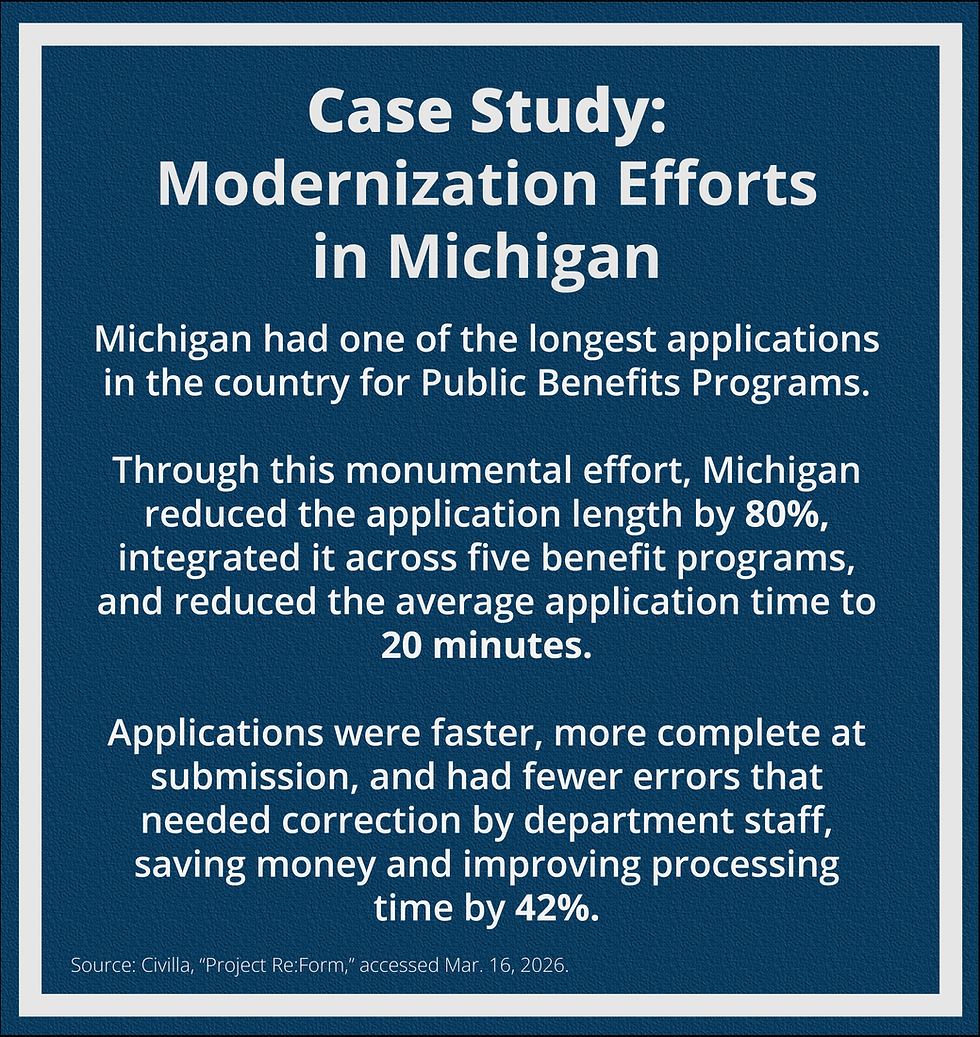
The Medicaid application process can be tedious and difficult for applicants. There are options to fill out paper application forms or to apply online, which requires an email and the creation of an account.12 While the application is nine pages long for Medicaid, additional forms or supporting documentation may be required to verify citizenship, income, and residence.16 Submission of incomplete applications results in document requests and multiple delays, or 15-day extensions in application processing times beyond the 45-day federal application processing requirement.13
Process improvements encompass application processing, renewals, and appeals. One challenge that connects all three of these activities is the administrative burden on eligibility staff. Reliance on temporary staff is inefficient because of the extensive training required to become proficient in eligibility tasks.[xiv] Overreliance on overtime can lead to burnout and negatively affect applicants' customer service experiences.15 From July through October 2025, DPHHS used over 4,000 hours of overtime specifically to address backlogs in determinations, costing the state over $200,000.14
Simplifying eligibility verification and leveraging available data can ease the administrative burden on eligibility workers and applicants. Strategies for improving this process include:
Better communication about what documents and information are necessary before starting the application;
Providing information on how long an average application takes to complete, and;
Communicating next steps and processing timelines.
These improvements would improve trust in the process and reduce confusion or unnecessary calls to the help line.17
Expanding Data Sharing for Medicaid Redeterminations Reduces Errors and Disenrollment
Redeterminations, or renewals, also contribute to the overall administrative burden for Medicaid beneficiaries and DPHHS Staff. Montana has a low renewal rate, and over two-thirds of non-renewals are due to procedural issues, such as missed communications or paperwork not being submitted.18 When churn occurs, rather than eligibility staff processing a single renewal, they process a renewal, remove the enrollee from coverage, and then process a reapplication from the same eligible person, vastly increasing the administrative work for a single enrollee’s participation in the Medicaid program.16 Other costs associated with churn include delayed care and less preventative care, increasing treatment costs due to increased severity and delayed diagnosis.20

Improving renewal rates through “ex parte” processes is one approach to reducing administrative costs. Ex parte renewal is when an application is renewed using available data and does not require forms or interactions with the beneficiary. Historically, Montana has had a low ex parte rate, requiring Montanans to submit documentation to verify eligibility. In some states, such as Kentucky, 81 percent of Medicaid renewals are completed through the ex parte process, with only three percent being disenrolled for procedural reasons, while processing four times the monthly renewals Montana processes.19 Montana can improve ex parte rates through the use of ‘express lane eligibility’, which allows for the use of findings from other benefits programs such as the Supplemental Nutrition Assistance Program (SNAP), Temporary Assistance for Needy Families (TANF), Women, Infants, and Children (WIC), Federal Housing Assistance, and Head Start Programs.20 DPHHS has advantages over other states in implementing this kind of data sharing, as SNAP, TANF, and WIC all fall under DPHHS.
Data-sharing agreements can be made with any public agency, including those administered by a Tribal Nation, honoring the government-to-government relationship between Tribal Nations and state governments.22 Increased efficiency and reduced administrative burden on enrollees and DPHHS staff can reduce churn, duplicative administrative work, and the risk that coverage will be discontinued due to an enrollee missing a piece of paper in the mail confirming information that the state can access from another program or agency. Other activities that can improve redetermination response rates include clear communication with enrollees about redetermination and using text messages and phone calls rather than relying solely on mail and email for notifications.
Enhancing Medicaid Customer Service and Access Points Can Decrease Unnecessary

Coverage Loss
Throughout the application and redetermination processes, it is important to acknowledge how enrollees and applicants receive information and interact with DPHHS and Medicaid. In 2015, almost a quarter of Montanans lacked internet access in their households, whereas more recent data indicates that over 90 percent of Montanans have an internet subscription.21 Montana’s expanding digital infrastructure offers new opportunities to strengthen access to services across the state. Supporting Tribal Nations in advancing broadband access and technology infrastructure is a key part of this progress, as on average, a Tribal member living on a reservation is more than twice as likely not to have a computer or internet access compared to the state average.22 This lack of access, coupled with few in-person supports in rural communities, also results in increased challenges accessing public benefits programs.
Changes in how people access the internet impact how people interact with information and government systems. However, DPHHS and state government agencies still rely heavily on physical mail and phone hotlines with long hold times and limited callback options. Even when communications or requests are sent by email, they often require printing, filling out physical forms, and scanning or faxing to respond adequately. 23 It is unclear and difficult to parse out what text message capacity DPHHS has access to for communications with Medicaid enrollees. In 2022, DPHHS reported implementing text reminders to update addresses when the department had received returned mail from a client and when the client’s case was being renewed. Samples of those messages lack case-specific information, such as missing documents, and either provide the helpline number or direct the client to OPAs.24 During the 2025 Legislative session, DPHHS stated it did not have text message capacity for due date reminder messages.25 Implementing a more holistic approach to text reminders across all actions needed to be taken by enrollees, especially with upcoming changes, increased need for documentation and reporting by enrollees, could help prevent eligible and compliant enrollees from losing coverage.
Leveraging Technology Advancements Lessens Administrative Workload and Improves User Experience
DPHHS does not have application systems optimized for mobile devices, such as tablets and smartphones, making it difficult for those without a computer to apply or renew for Medicaid and for those accessing information on mobile devices. Solutions for the shifting landscape of internet access include optimizing the Medicaid application website for mobile devices and creating downloadable mobile applications for tablets and smartphones.24 Mobile-first website optimization means building websites for smaller screens and mobile devices first, and then scaling up for larger desktop or laptop computers, which can reduce errors caused by application fields that are not visible to applicants due to poor adaptation to screen size differences27. Mobile device apps can also be a solution for the challenge of accessing public benefits from a variety of devices. They have additional capabilities, such as scanning and uploading documentation, and push notifications. These notifications are like those used by social media or text, helping remind applicants and enrollees of time-sensitive tasks and future deadlines or requirements.28
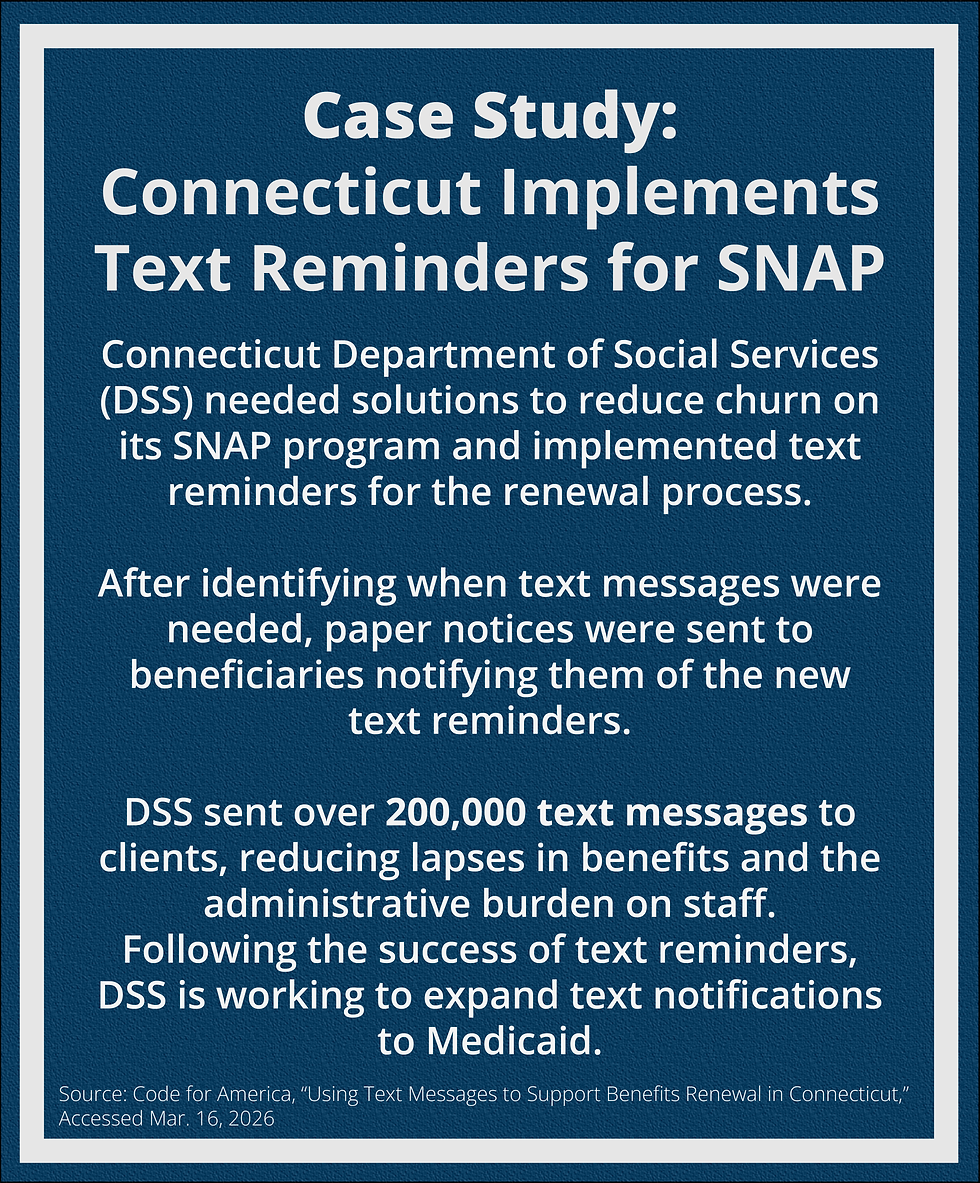
While adapting application systems to modern technology requires initial investments, the increased efficiency of document submission, application completeness, and accuracy would decrease application processing times and associated staff labor.28 Applications and updated web portals could also offer the added benefit of showing that applications have been received, are complete, and provide estimates of approval timelines, thereby reducing hotline call volume.
Digital improvements can expand access and streamline Medicaid processes, especially when they build on and strengthen the support structures already in place at DPHHS. The Medicaid population is diverse in age, ability, race, and comfort with technology; maintaining face-to-face assistance is essential to ensuring equitable access.28 Gaps in access have been long-standing due to distances between Offices of Public Assistance (OPAs), 19 of which were closed in 2017; long wait times on the Public Assistance hotline; and renewal and application processing backlogs.29 Increasing the number of physical locations for application and case assistance can significantly improve the likelihood that an applicant completes the application process and enrolls in coverage. 30 Access to in-person support may also reduce and divert use from Montana’s overburdened hotline, further improving call wait times and reducing call volume.
Improving Montana’s Medicaid Customer Services Supports the State, Communities, and Montana Families
Improvements to platforms, in-person assistance, and public assistance hotlines all work together to create a more efficient, accurate, and cost-effective, Medicaid system. Additional hours spent processing information the state already or going back and forth with an applicant to obtain unnecessary documentation creates additional costs at the state level and wastes enrollee time. Time is valuable. On the state level, that equals countless hours of extra staff labor due to red tape and administrative overhead. For the client, it takes time away from their jobs, family, and community. Medicaid plays an important role in keeping employees healthy and at work, reducing the number of days kids miss at school, and preventing rural and critical access hospitals from closing due to the costs of uncompensated care. Medicaid boosts Montana’s economy, supports health care access for all regardless of enrollment status, and over the last ten years has helped reduce the number of uninsured in the state.1 Medicaid works, and the state could improve how it serves working Montanans and to operate as efficiently as possible.
Key Takeaways on How States Can Improve Medicaid Administration and Customer Service
DPHHS can improve applications by listing the required documentation and the estimated time to complete it before the applicant begins the application.
DPHHS can communicate to applicants that their application was successfully submitted, its completeness, the next steps, and processing timelines.
DPHHS can improve renewals by increasing the use of ex parte processes and by sharing data with other state agencies and Tribal governments.
DPHHS can reduce procedural disenrollment, thereby decreasing churn and the administrative burden on state staff and enrollees.
DPHHS can improve communication by using multiple modalities, such as text and email, in addition to mail, to ensure enrollees receive important information related to their cases.
DPHHS can improve access to Medicaid through mobile-first website and application development, as well as mobile device apps.
DPHHS can increase the number of OPAs in the state, increasing physi
cal access to application assistance.
DPHHS can improve communications and notices by using plain language and including clear case-specific information and the action needed from the enrollee.
1 KFF, “Health Insurance Coverage of the Total Population” Feb. 19, 2026.
[2] Ward, B., ABMJ Consulting, “The economic effects of Medicaid expansion in Montana: A review,” presentation to the Modernization & Risk Analysis Committee Jan. 9, 2024”
[3]Wilke, S., et. al, “States Can Reduce Medicaid’s Administrative Burdens to Advance Health and Racial Equity,” Center on Budget and Policy Priorities, July 19, 2022.
[4]Georgetown University Center for Children and Families, “Tracking State Readiness to Implement HR 1,” accessed on Feb. 19, 2026.
[5]Center for Medicare & Medicaid Services, “State Medicaid and CHIP Eligibility Processing Data,” accessed Feb. 19, 2026.
[6] Montana Healthcare Foundation, “2025 Medicaid in Montana,” Jan. 2025.
[7] Department of Labor and Industry, “Medicaid Expansion & Montana Employers,” Jan. 2025.
[8] MBPC calculations using Department of Health and Human Services, “Montana Medicaid Enrollment,” accessed Feb. 20, 2026.
[9] U.S. Census Bureau, “QuickFacts Montana, People Race and Hispanic Origin,” accessed Mar. 30, 2026.
[10]Bahr, J., “Medicaid Expansion in Indian Country: Improving the Health of Individuals and Communities,” Montana Budget & Policy Center, Mar. 7, 2024.
[11] Warne, D,, et. al., “ Barriers and unmet needs related to healthcare for American Indian and Alaska Native communities: improving access to specialty care and clinical trials,” National Library of Medicine, Apr. 3, 2025.
15Department of Health and Human Services, “ SNAP, TANF, and Health Coverage Assistance Application,” accessed Mar. 31, 2026.
[13] Department of Health and Human Services, “Combined Mediciad103-1 Application, Eligibility Determination & Furnishing Assistance,” Feb. 1, 2025.
[14]Governor’s Office of Budget and Planning, Fiscal Note HB230, Jan. 23, 2025.
[15]Office of U.S. Surgeon General, “Work-Place Mental Health and Well-Being,” Oct. 20, 2022.
[16]Department of Health and Human Services, “Contracted Staff and Overtime Report,” Dec. 16, 2025.
[17]Erzouki, F., “Lessons From Unwinding Offer Opportunities to Streamline Medicaid, Improve Efficiency,” Center on Budget and Policy Priorities, Apr. 3, 2025.
[18]Center for Medicare & Medicaid Services, “Medicaid and Children’s Health Insurance Program Eligibility Processing Data Report Specifications” Accessed Feb. 20, 2025.
[19] Center for Medicare & Medicaid Services, “November 2025: Medicaid and CHIP Eligibility Operations and Enrollment Snapshot,” Feb. 27, 2026.
[20] Mann, C., Center for Medicaid and State Operations, memo to CMS Regional Administrators, “Express Lane Eligibility Option,” Feb. 4, 2010.
[21] U.S. Census Bureau, "Types of Computers and Internet Subscriptions, American Community Survey, 2024 ACS 1-Year Estimates Table S2801,” accessed on Feb. 16, 2026.
[22] MBPC calculations using U.S. Census Bureau, "Types of Computers and Internet Subscriptions, American Community Survey, 2024 ACS 5-Year Estimates Table S2801,” accessed on Feb. 16, 2026.
[23]Department of Health and Human Services, “Redetermination Supplement,” accessed Feb. 13, 2026.
[24]Department of Health and Human Services, “Sample Reminder Text Messages for Members,” accessed on Feb. 15, 2026.
[25] Governor’s Office of Budget and Planning, Fiscal Note HB885, Apr. 4 2025.
[26]Ambegaokar, S., Podesfinski, R., Wagner, J., “Improving Customer Service in Health and Human Services Through Technology,” Center on Budget and Policy Priorities, Apr. 23, 2018.
[27] Palmer, D., “The Missed Opportunity in Online Benefits Applications: Mobile First,” Code for America, Apr. 4, 2019.
[28] Civilla, “Project Re:Form,” accessed Mar. 16, 2026.
[29] Montana Food Bank Network, “One Year Ago: 19 OPA offices closed in Montana,” Dec. 22, 2018.
[30] Enroll America Families USA, “In-Person Assistance Maximized Enrollment Success,” Mar. 2024.

RR 88 làm mình chú ý đến cách bố cục tạo sự khác biệt giữa những cụm nội dung khi mình lướt casino, nổ hũ, game bài và bắn cá. Mình thường kéo qua một đoạn tương đối dài rồi quan sát xem tiêu đề, hình ảnh và khoảng cách có giúp nhận ra mình vừa sang một phần khác hay không. Những vị trí khiến mình chú ý được ghi nhớ trước, còn mô tả chỉ được xem kỹ khi mình quay lại. Cách quan sát này giúp mình kiểm tra khả năng đọc tổng thể của giao diện thay vì chỉ xem từng lựa chọn riêng. Khi các cụm có ranh giới rõ, mình dễ chia danh sách thành…
This burden of convoluted procedures and endless waiting immediately reminds me of the game run 3. Like the game's protagonist, people here must constantly run, jump, and weave through a series of regulatory "gaps" or administrative hurdles just to hold onto their insurance cards. A single slip-up or delay with paperwork means instantly "falling out of the game" and having to reluctantly start all over again.
trong lúc trải nghiệm thực tế trên cả điện thoại và máy tính, tôi thấy SHBET duy trì được sự nhất quán khá tốt về mặt hiển thị. các khu vực chức năng được bố trí rõ ràng giúp người dùng dễ dàng xác định nội dung mình quan tâm. khi sử dụng, tôi nhận thấy thể thao điện tử được cập nhật theo từng nhóm riêng còn xổ số lại được sắp xếp theo hướng dễ theo dõi. tốc độ tải tương đối ổn định và các thao tác điều hướng diễn ra mượt mà. điều này giúp trải nghiệm trở nên thuận tiện hơn trong quá trình sử dụng lâu dài
Trong quá trình mình tiếp tục quan sát https://luck8.zone/, mình nhận thấy cách tổ chức nội dung được duy trì khá ổn định nên việc tìm kiếm các chuyên mục diễn ra thuận tiện hơn. Những khu vực như casino, game bài và bắn cá được phân chia rõ ràng giúp việc điều hướng không mất nhiều thao tác. Mình thấy giao diện được thiết kế theo hướng trực quan với các nhóm nội dung hiển thị cân đối và dễ theo dõi. Trong lúc trải nghiệm mình thử casino và game bài thì tốc độ phản hồi duy trì ổn định, thao tác chuyển đổi khá mượt, việc quan sát nội dung diễn ra liên tục và cảm giác…